“Learning never exhausts the mind”
~ Leonardo da Vinci
What follows is a series of blog posts from prior travels, published on various sites. They have been included here on my new site as I collected information into a single location. Dates for the original publication are noted on each blog.
2010 – NSTA – SINO CONFERENCE IN SHANGHAI
HOMEWARD BOUND (November 23, 2010) Well, it’s “Back to the Future.” Just as we had all come together in singles, forming groups of two or three, so did we disperse. Due to different flights, we met in the lobby of the hotel at different times (mine being 5:45 a.m.) and were shuttled to the airport with people who were returning to the same city with us. There was no large group goodbye, there was no ending group hug, but rather each of us heading back to our respective cities from whence we came. We left on Sunday morning, Shanghai time, and according to the flight itinerary, we arrived an hour later, Detroit time. Not quite that quick of a trip, but due to the time difference, we were literally going “back to the future.” We were going “back” due to the difference in time and location of the time zones, yet we were returning to our future. More knowledgeable about our counterparts in China and with a greater understanding of the people that we met and their intricate culture, which is multifaceted.
When we reached Detroit (or LA or Chicago or wherever each plane was headed) we returned to being an individual or pair headed for their own gate—to return to Wisconsin, or DC, or in my case Shippensburg. The group disbanded physically in a rather quick manner however I think that many of us will be the “sticky rice” that was referenced earlier and keep in touch. After all, each of us has a commonality that binds us together—the pursuit of excellence in science education in order to improve the education of our students, whatever the level. This pursuit in itself impacts the future of not only the country in which we live—but also countries around the world as we realized by working with our friends, colleagues and counterparts from half way across the world.
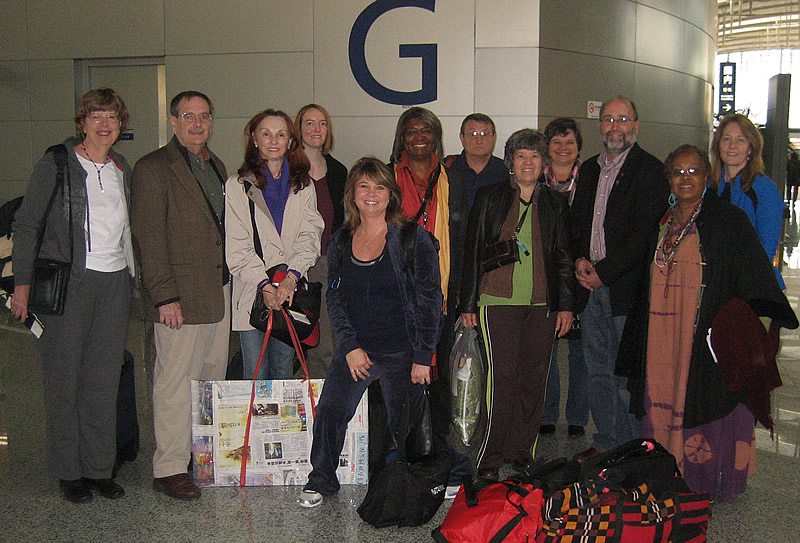

STICKY RICE OR LOOSE NOODLES (November 20, 2010) “Be like sticky rice … not loose noodle.”
You probably think I have lost it by now. What could she possibly be thinking? Well, this was the quote of the day from our tour guide Jennifer on our bus. Today was a field trip day. Well, the entire experience could be considered a field trip, but today was a day where we loaded the buses and headed out of Shanghai to see an “old town,” which we were to compare to Shanghai as a “new town.”
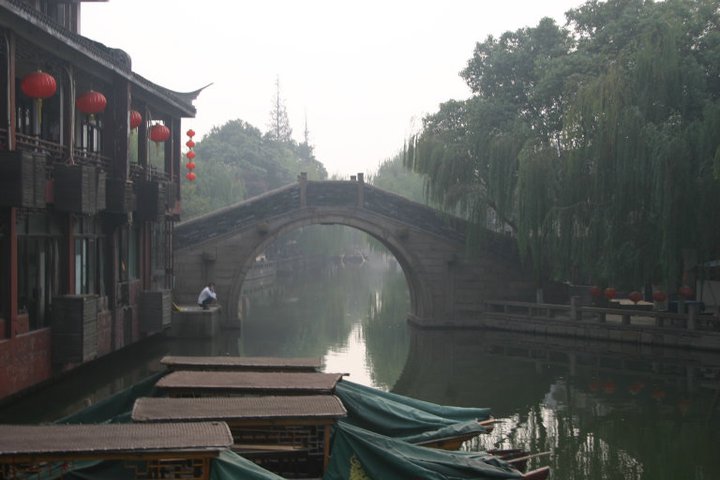
The group set off this morning to Zhouzhuang, which is a water city about an hour and a half west/southwest of Shanghai. It was described to us as being a “very beautiful city” with many bridges and the river. When reading about it in tour books and on the web, the city is actually about 900 years old and has many “historic” type homes. In total, there are 14 bridges in Zhouzhuang, which was made famous by a painting which was purchased by some American gas or oil tycoon. We watched the sites go by as the bus departed the city for the suburbs which seemed to be a continuation of the city—hundreds of towering structures that were apartment buildings; we watched as we entered a rural area which did have agricultural aspects—rice paddies and other types of plant cultivation; and finally we watched as we entered this “small” town which really looked more like a small city.
We listened as Jennifer gave us information about our time frame, where the facilities where (and yes most of the stalls had squatties) and finally directions for following her and her waving yellow flag. At that point, she gave us the initial directions as we were to progress directly to the boats for a boat ride through the city and to the entry point into the town—which has a charge. Her specific directions—you will have time to shop later, do not stop and look or take pictures—“be like sticky rice—not loose noodle.” Many of us decided that was the phrase of the day and was a perfect way to describe her expectations.
We were somewhat like sticky rice—with a few loose noodles. We wandered, took pictures at the touristy spots to take pictures, and finally did board the boats for the short ride. Eight people to a boat. Oh, and there was no translation problem when the person who would paddle the boat wanted people to switch seats due to an imbalance in weight shall we say. Jennifer directed us to where we should meet in exactly two hours—which included lunch at the restaurant—the “blue guy (Haibo) near the big marble wall.” Off we went—to lunch which I must say was absolutely the best food of the trip so far (minus the chicken feet that the removed from the table) and then to explore the town and shop. On the excursion to the starting point, there was much to see and plan to buy—handcrafts made by local artisans; Chinese calligraphy; paintings; trinkets, and everything in between. There was also food—lots of it … and not what you would expect.
The smells of the area assaulted your senses—you could walk by places with fish floating in containers right next to the sidewalk; plants were being cleaned in front of you for preparation; and every kind of meat was on display either sitting in or hanging from stations at the stand. I was not adventuresome enough to try and of the local delicacies. Everything you touched had texture; everything you saw had color or intricate details; everything you heard was different—it would get quiet and you could hear a local woman singing songs or a musician playing a traditional instrument and then it would get loud as a tour group passed by with their own flag; everything you smelled simply smelled like something you weren’t familiar with.
We ventured in twos or threes, teamed up with other groups, compared purchases and sent people off in the direction of the stall if they were interested in something we bought; and snapped photos at every turn. As a group we were able to laugh and interact in a way that was informal allowing us to learn about the location, the people, and each other. When 1:50 p.m. came around, we were to be at the wall near the blue guy and Jennifer and Eva (the other tour guide) had us walk single file past them so they could count us—we weren’t demonstrating our skills at being sticky rice—we had become even more loose noodles due to the many things that we could do during the time there.
The day ended with a ride back to Shanghai, shopping for some, and dinner at Shanghai Uncle—a restaurant with a local flavor, as it was described to us.
Hopefully when we return, some of Jennifer’s words of wisdom and direction will follow us home—we have one more day here in this beautiful city and already we are starting to talk about a reunion in San Francisco at the NSTA National Conference this coming spring. I truly hope that the new friends I’ve made and the friendships that have deepened will connect throughout the upcoming months and be more like sticky rice than loose noodles …
STUDENTS, LESSONS LEARNED, AND GOALS (November 18, 2010) Today was the day for students, lessons, and—for me—personal goals. Now, this may sound like the students are those in the classes we teach or observed and you would be correct. However, the word student took on a much more meaningful connotation today for me and I hope for others. We, the participants in the conference on both sides were the students in that we were learning from each other, our colleagues, and the experience at hand. We also visited schools where we were able to interact with students allowing us to be in a familiar setting.
The morning was spent in concurrent sessions on similar topics from yesterday. The structure—the Chinese present a series of case reports related to the topic, engage in discussion, and then we, the Americans, present on the same topic. While the original intent was that we would do similar things, there was something lost in translation at some point. The group from NSTA convened teams that would present the topic as a team approach, having worked several months on our presentations. I appreciated this approach in that it allowed me to better know some of my colleagues—David, Walter, and Piyush—as well as have a discussion (albeit via email or conference call) on the topic at hand. Our topic was how we prepare teachers in this country, which focused on a historical overview of the structure of teacher certification. In contrast, we received different examples of programs that work with teacher preparation from our friends in China. Each was interesting and informative, just simply assembled in a different manner than we expected.
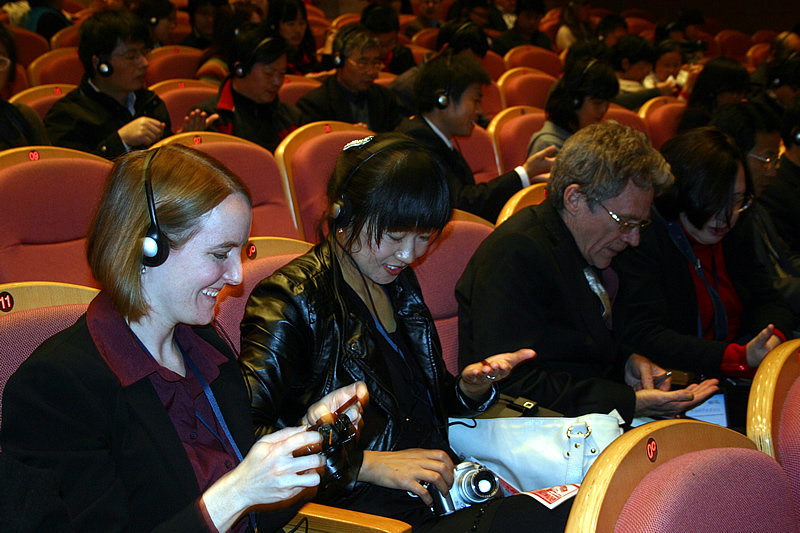
One example of our becoming students today dealt with the translation. While the past two days were simultaneous translation, today’s approach was sequential translation—we say something and then it is translated. This actually was an interesting experience, identifying where to break to allow enough information to be provided, but not too much that the translator would lose the concept presented. Back and forth went the sharing of information—first in Chinese to English and then English to Chinese. My lesson learned, related to the preparation of presentations, is that it may not always go according to the plan given; however, in this case the task was successfully accomplished if you stay flexible. Staying flexible is not always an easy goal—so today was a great reminder of how much you can learn if you do remain flexible.
We were also students learning about the other countries programs and efforts to improve science education. For example, one presenter was sharing that the Chinese education programs are attempting to move away from traditional programs towards competency based programs. This point was reiterated on the American side in that we are doing the same. One aspect that did amaze me during the presentations was our counterpart’s ability to interweave examples of their programs and efforts with those of other countries. Singapore, Taiwan, Australia, and France were but a few of the countries that were mentioned. Usually the connection was related to something the other country has done that China has adapted or modified. If we are all lifelong learners—it was clear today that I—and I would venture to say, some of my colleagues—aren’t as skilled at knowing what China is doing as quickly as they know what we are doing. The lesson I learned from this aspect is that it is a large global world, and too often I get caught up in the happenings within America only. My goal for the future is to broaden my horizon to learn more about science education efforts worldwide.
Following lunch, one of the highlights of the trip thus far: visiting a primary school and high school. First we were treated to a presentation at Haihua Primary School, which would be considered a “key” school, or as we call it, “magnet school.” This elementary had as an emphasis science and technology. Much of the focus was related to the environment and man’s impact on the environment. Upon entering the room, the delegation naturally gravitated to the back of the room where students were sitting at different stations, ready and willing to show us their activities. After being gently guided to our seats for a presentation about the structure and purpose of the school, we were then able to interact with the students, ask them questions, observe them building or constructing things, and get a sense some activities that were identified as lessons. Activities included using paper magazines to make ecological holders for pencils as well as constructing cars from kits provided. Several students also demonstrated two “magic” activities which had a connection to science content. It was enjoyable to meet these students, most of which could converse with us in very good English (thank goodness, since we weren’t able to converse in Chinese). They answered our questions, showed us their activities, and were generally pleased to represent their school.
This was one of the factors that came to the forefront at both schools—a sense of pride in what they were doing and a sense of belonging to their school. Students at the high school were engaged in demonstrating similar activities as well—robotics and a biology investigation. While not as conversant with us, the sense of enthusiasm was present for what they were doing. We had a presentation and question-and-answer session with the administration and teachers at Luwan Senior High School. One of the interesting answers to the question “What are your challenges in the classroom?” related more to the big ideas than what we often hear if American teachers were to answer this question. There are many reports that describe teacher challenges as classroom management, class size, impact on time, lack of parental involvement, as well as a myriad of others all of which do impact learning and the classroom environment. The teachers talked about average class sizes of thirty-five students and having less instructional time in the week than we have. The teachers provided reasons such as “breaking traditional thinking of the students,” how to get them to think independently without the help of a teacher, and “how to make the lesson more interesting to meet the needs of the students” were answers provided. My lesson learned here is that we often focus on the logistics and process of running the classroom, which I know is important, and often forget that there are bigger ideas to consider such as those mentioned by our Chinese friends. My goal is to try and remember the bigger picture even when the day becomes overwhelmingly filled with those minor details.
Finally, the last student experience of the day was an individual one. I was fortunate to have a former graduate student and graduate assistant Tian Shen join our team for today’s presentation. Tian was at Shippensburg University for two years obtaining his Master’s degree in Curriculum and Instruction and has since returned to his home city of Shanghai, where he teaches at the Shanghai International School High School Division. While not a science teacher, as he teaches 7th grade math, Tian was able to join the team and provide comments related to his experience of taking classes in a teacher preparation program during the session. The excitement he demonstrated at being asked to participate in this event made the day absolutely wonderful. He was an outstanding student in our department and is obviously becoming a well-respected teacher at his school. The most important lesson of all is that involving your students engage in opportunities such as these as well as those that are present in your classroom allows them to grow. What seems like a simple goal—involve more students in opportunities that meet their needs and desires is often overshadowed by the two lessons mentioned above—only focusing on the local agenda, the here and now if you will, as well as becoming consumed by the daily logistics and not looking towards that big picture. My final goal that I set today is to involve more students in opportunities and programs in which I am involved, to help broaden both their and my own views of education in a global society.
SCIENCE BRIDGES MANY BARRIERS (November 17, 2010) Today in one sense was a long day—this was heard stated by many of the participants here. It wasn’t that we were uninterested in what was said; it wasn’t that we started any earlier or finished any later. It might have felt like a long day since as one person stated –the adrenaline rush of being in a foreign country on such a journey is starting to wear off and jet lag may be setting in just a bit. The reason I think it felt long to others and specifically the reason it felt long to me was simple—with the exception of tea breaks (which by the way is customary everywhere you go) we sat. To clarify—we sat on our butts all day and listened to speakers—eight in all. Now please don’t get me wrong—the topics the speakers presented on were wonderful—informal science education, preparation of teachers, curriculum design, and research relating to improving the field. There will be more on these later, however to get back to why the day felt long—it’s because the consensus among an informal survey of participants was—we rarely ever sit that long. One person even went as far as to comment that we now know what our students may feel like at the end of a day.
Today’s presentations from both sides presented interesting and informative perspectives to consider. One of the main points that jumped out towards the end of the day as Elizabeth Mulkerrin was speaking was when she said something like science is the bridge to helping students learn in reference to a particular program she was highlighting. That phrase summed up the entire day for me. Science truly bridges many barriers. One of the feature presenters from the Chinese delegation spoke about two priorities that the Chinese government has set for education in the next ten years—equity and quality. Equity in China means exactly what it means in the United States—addressing the situation of students in poverty, ethnic minority areas (an interesting fact that we learned today was that the Hun group was the most prevalent in China), bringing equity to all schools and eliminating key schools, as well as allocating more resources for schools. Dr. Wang Dinghua discussed the need to address dropout rates, support special education and migrant workers (not something I ever really considered, to be honest) as well as their equivalent of “latch-key kids.” Point by point he could have been talking about issues and concerns in the United States. Quality again was repetitive of what we hear regularly—improving all schools, laying a solid foundation for future development and education. However—there was one that we as Americans are just starting to see on the horizon (fingers crossed that the direction of travel continues) and that is having all students complete their studies with science literacy. He pointed out that the 3Rs are important in helping people communicate, however science literacy was important in helping the country move forward as a nation. He connected it to energy, the environment, sustainability and what he referred to as a “higher R requirement”—that of responsibility. Responsibility to each as an individual, society as a whole, and the future of the country.
As I understood his presentation, science is the key connector between all aspects of the future as the Chinese see it—it bridges the past with the future. Dr. Dinghua continued to discuss the components that go into making their national curriculum (which does have a certain percentage determined by the local provincial offices) better and future- looking—teacher efficiency, a reduced workload for student homework, the need to foster creativity and continuing to strengthen hands-on experiences of the students. His point was further reflected by a statement in Dr. Liu Enshan’s presentation on biology curriculum later in the day. He stated that part of the national agenda was in order to “maximize human capital to build a creative country; science education should play a critical role in general education.” He further discussed that science is taught in grades 3–11 with integrated content being covered up through grade 9 followed by discipline specific topics for high school. Dr. Enshan focused on a change that has been implemented into the biology curriculum in recent years—that of inquiry.
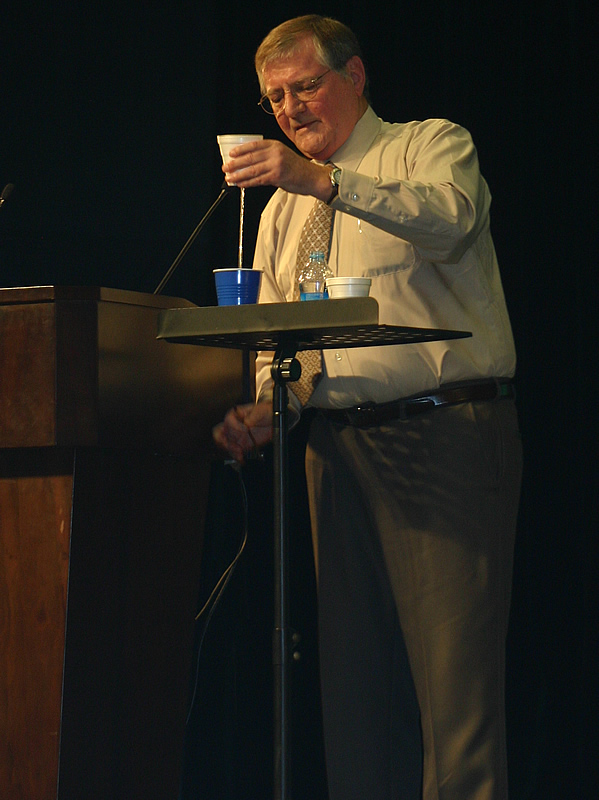
Which led nicely into the session presented by Dr. Alan McCormack and Dr. Karen Ostlund. Alan and Karen focused on how to engage students, including preservice educators, in inquiry based experiences. Discrepant events were presented which resulted in an equal reaction between the Americans and Chinese—a look of wonder as well as a brief bit of confusion as the water should have come right through the glass that had a hole poked in it. What followed was another example of science serving as a bridge. Even though we were still SITTING, they had us do the “fish inquiry”—you know the one—where a red fish cut out of cellophane like put on the palm of your hand and you observe what happens to it … does it curl up, have its head move or its tail. Next they distributed simple materials and asked us to design an experiment to test our hypothesis as to why the fish moves. If you can picture Chinese educators who speak little English, and American educators who speak almost NO Chinese, sitting side by side in an auditorium, communicating with each other through pictures and hand gestures designing and conducting an experiment—to observe the event was unbelievable but to participate in the opportunity was amazing. The act of “doing science” crossed barriers of language and allowed us to engage in a meaningful way with each other thus making additional connections between individuals.
In considering Elizabeth’s statement and the events of the day—science truly does bridge many barriers that often divide individuals and countries. Classroom science bridges the achievement gap according to information presented by Dr. Janet Carlson and Dr. Arthur Eisenkraft today during their presentations. Science information brings nations together for summits on global warming, nuclear energy, and natural disasters. I am not saying that everyone reaches the table with the same goals or agrees on the desired outcomes—but that too is part of science—presenting your side and evidence in a persuasive argument and then should it come to it– agreeing to disagree—but continuing the conversation and pursuit of scientific knowledge. Science education has brought together all of the people attending this forum who will now have connections to maintain in the future. Some may be intermittent, while others may be regular. The important point that I learned from today is that there are many ways to cross a divide or conquer a barrier—and science education and the experiences at this forum will help us all to build many bridges and connections well into the future.

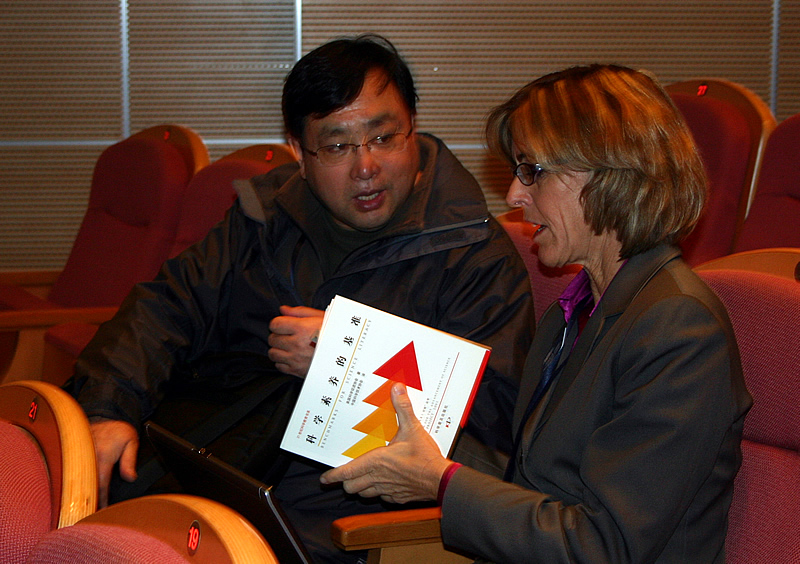
US- SINO FORUM GETS UNDERWAY (November 16, 2010) Where did Monday go … well, due to the time difference, the delegation didn’t actually arrive until Monday evening … so today was the first day of the Forum. Some members of the delegation headed over this morning to an optional event—the Shanghai International Forum on Science Literacy of Precollege Students, while others took advantage of the down time to either relax, sleep in, or wander around the Yu Garden area, which is home to a series of shops and bazaars selling everything from silk scarves to Chinese tea to pearls.
The actual opening of the US–Sino Forum began after lunch at the Sinan Building which is where we heard the opening ceremony and keynote speeches. Opening comments were given by Mme. Chen Saijuan from CACSI (Chinese Association of Children’s Science Instructors” and Dr. Francis Eberle, Executive Director of NSTA. During Francis’s opening comments, he remarked that the differences between our countries are as important as the commonalities as we have much to learn and share. He further commented that the future of both countries is tied to science and education. This struck me as an important point, because earlier that morning, I took full advantage of trying to regulate my clock by sleeping in a bit and then wandering around Yu Gardens. While there with a colleague Steve Rich, we came across a group of upper elementary school girls in their uniforms, complete with backpacks and what appeared to be a worksheet in hand. Steve and I immediately assumed that they had a series of tasks to complete while there as they looked like they were searching for specific locations (albeit stopping and sharing in the treats for purchase as well). It was interesting to see these school aged children from China acting just like I have observed school age children from the United States doing. They were writing things down when they “got an answer”; laughing and joking with each other and they were obviously engaged in this time outside of the traditional classroom.
I have yet to visit a Chinese school so I am not sure what their traditional classroom even looks like, however, there were many similarities between my observations of these children and those from my home state. I don’t know what subject they were trying to do or even if they were there for school reasons. I am assuming so as it was mid morning which is after the “normal” school start time and they were in uniforms complete with backpacks. I noticed the similarities first, rather than the differences which brings me back to Francis’s opening points. There are many similarities to my home world even in this bustling city. I have yet to feel “out of my element” or “in a foreign land” if you will—rather I found it easy to read the street signs while on the bus yesterday and today (even though I have no orientation as to where I am going); could locate the traditional types of stores—convenience stores, fresh fruit stands, tourist places and yes—even a Pizza Hut and McDonalds; and most of all, I was able to navigate around a new city with some basic skills and a map. The hardest part of the trip so far was figuring out how to turn the lights on in my hotel room and then keep them on (one must insert their key card into a wall slot while in the room for the lights to remain on—once removed, the lights shut off in a few minutes which is one way to conserve energy I guess).
Following the opening comments, we had the pleasure to hear a keynote speech from both the Chinese Science Educators and the US delegation. Mme Wei Yu is an academician of the Chinese Academy of Engineering as well as holding many offices in associations such as the Chinese Association for Science and Technology. She is internationally cited for her efforts in promoting “Learning by Doing” which is an inquiry-based science education project for grades one to six. Her presentation focused on her work in designing and implementing “Learning by Doing” and the successes she has had as well as the challenges she has faced. One of the points she reiterated was that science and education are important to strategic issues that affect our future. She also stated that science teachers are essential to reform … so we must share both countries experiences of teachers because we can learn from each other and inspire each other. The US Keynote was given by Dr. Norman Lederman, who is Chair and Professor of Mathematics and Science Education at the Illinois Institute of Technology. His speech also focused on the promise and challenges of science education reform in the United States.
Throughout both presentations, many commonalities emerged—that both countries have teachers who put effort into and are dedicated to their fields; that global issues need to be addressed and worked on together—because we have much to share with each other; that evidenced based and science based reform requires teacher training and money; and that both the US and Chinese views on elementary science education are not always at the forefront of the daily teaching agenda since there is no mandatory test that measures young student learning. The first several were interesting to hear, but the last one was somewhat of a surprise for me. It appears that both countries teachers of science are fighting to make science a subject that receives priority in schools. The differences were few but demonstrated the major difference between our countries. China has a national curriculum and can guide what happens in all schools from as Mme Wei Yu stated a “top down approach” where as the US has local control of schools. Another difference that was illustrated related to Dr. Lederman’s statement that often there is “teacher resistance to change” in our country since it is often a swinging pendulum in the education arena, however, teachers “follow” the directives that are provided by the Ministry of Education in China. Before I get emails, I am not making a judgment regarding which it should be or why as I do not have enough information about the Chinese system to draw a fair comparison, rather I am just simply stating one difference that was clearly pointed out.
Regardless of which you focus on, the similarities or the differences, there is no doubt that both countries delegations have entered into the inaugural US–Sino Forum on Science and Education with open minds in order to build on a commonality—an obvious passion for our field and desire to improve education for our students.
NSTA IN SHANGHAI (Novemebr 15, 2010) According to the information about “My Flight” on the in seat monitor in front of me, it is 10:32 p.m. departure time and 11:32 a.m. at our arrival destination and the plane is somewhere north of the East Siberian Sea and Russia. We have 7 hours and 17 minutes of flying left, which means we are just about half way there.
Where is there? There is Shanghai, China and this particular flight has on board sixteen—well, maybe seventeen—of the members of the US team headed to Shanghai as part of the NSTA delegation to the US–Sino Forum on Science and Education which is to be held November 15–21, 2010.
I say “maybe 17″ members because that is the number that was supposed to be on board, but we weren’t quite sure if all members made the flight. All of us haven’t yet met formally, some of us know each other from different activities, organizations, or past conferences. Some of us are meeting each other for the first time. As our group gathered at gate A56, we each greeted and hugged others we knew, introduced each to others that were new to us, and started to become a larger group. We switched off watching our accumulating carry on luggage to run and exchange currency, get something to eat, and use the facilities. Our boarding passes were stamped after visas checked, and within a very short time of arriving at the gate, we were boarding the 777 and headed to Shanghai. Once on board, the chatter between group members continued, as many of us were seated close to each other. It is obvious that there is energy and excitement among the team members from our sharing of preparation experiences.
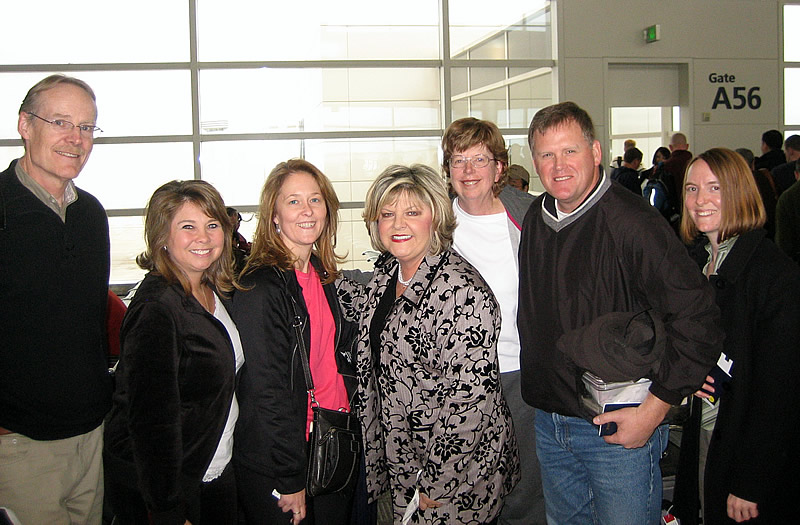
In total, there will be fifty members of this group who will convene in Shanghai and engage in conversations, discussions, and the sharing of ideas related to science education over the next several days. The travel was varied, each of us leaving our own home cities across the United States, merging in small groups at larger airports around the country, some of which included Los Angeles, San Francisco, and our group’s departure point of Detroit. Some team members who were leaving from different airports were in contact via text, phone, and email right up until the doors of the plane closed.
Throughout the last several months, NSTA members and science educators from across the country looked forward to this trip. People expressed an interest in participating, worked with Michelle at headquarters on applying for visas, were sent updates to the schedule as they became available and were reminded to “remain flexible”, and generally looked forward to the opportunity to learn about science and education in another country. During the application process, we were required to provide a statement of why we wanted to participate in this experience on our interest form so that the committee had information as they selected members of the delegation. Part of my narrative stated as “I believe that this specific forum will provide me with the ability to take my learning as an educator outside of the classroom and into a global arena, thus helping me to add additional knowledge in many professional areas. When it comes to the field of science education, we have as much to share with, as well as, learn from our Chinese counterparts. I hope this trip will provide that sharing opportunity that will serve as a connection point and bridge to future experiences and collaborations. In summary, the main reason that I am interested in attending this program is that I believe ‘experience is the best educator … even for an educator.’” And for all of my friends out there—yes part of my reason was this just sounded like an outstanding opportunity to do something I am passionate about—go and be with “my own kind”—science educators who share a love and passion for our field.
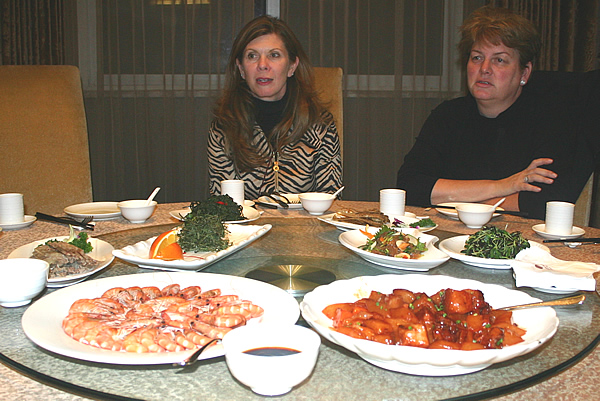
Over the next week, the NSTA group will meet with the CACSI group from China. CASCI is the Chinese Association for Children’s Science Instructors. I will blog more about the talks, meetings, and opportunities to visit schools and see local sights in the days ahead, but it is important to realize that this opportunity and experience is a dichotomy. It is really no different than other experiences we have all engaged in previously and will continue to do so in the future while at the same time this opportunity is extremely different. There is no doubt that people who know each other, as well as those who are just meeting for the first time and board planes to meet half way around the world is a bit exciting and adventuresome, but we as individuals do similar things each day in our “normal” lives as well. We as individuals go to class, meetings, and other events to form small groups of those we know only to be introduced to new colleagues or classmates and to form a larger group. The question that arises is in both situations, is “do we take advantage of the learning opportunities that present themselves” whether local or global?
According to that in-flight monitor in front of me, our group is scheduled to land at approximately 6:52 p.m. local time in Shanghai which would be early. And on that note, as I am somewhere between departure and arrival, I will sign off for now and try and catch some sleep.
 Learning, Lessons, and Living